June 1, 2026 · Environmental Law & Land Use
Disclaimer: The information provided in this article is for general informational purposes only and does not constitute legal advice. Reading this article does not create an attorney-client relationship between you and Ward & Rafter, LLP. Every legal matter is unique, and the information above may not apply to your specific situation. You should not act or refrain from acting based on any information on this website without first consulting a licensed attorney. If you have a legal question, please contact us to discuss your matter.
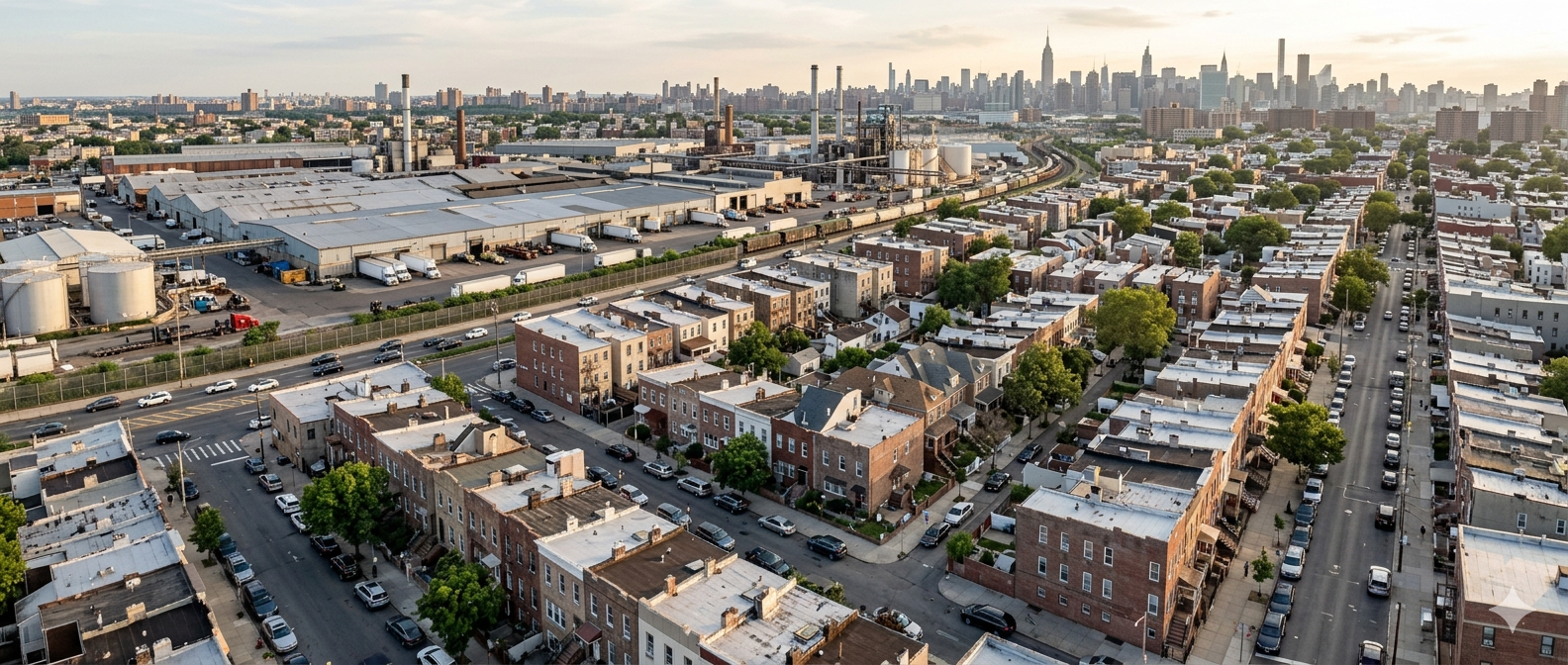
For decades, certain New York communities have carried a disproportionate share of the pollution generated by industrial facilities, waste transfer stations, power plants, and other environmentally burdening land uses. Many of those communities are low-income, minority, or both. As of June 12, 2026, New York State has formalized a legal framework that requires government agencies to take that burden into account before approving new projects. And when that framework fails, or when the damage has already been done, the law also provides a path for individuals to seek accountability on their own.
What Just Changed: The Environmental Justice Siting Law
New York's Environmental Justice Siting Law (EJSL), enacted in 2022 and recently implemented through DEC regulations finalized in April 2026, took full effect on June 12, 2026. The law amends the State Environmental Quality Review Act (SEQRA) to require that any agency reviewing a proposed project must now evaluate whether that project will cause or increase a disproportionate pollution burden on a Disadvantaged Community (DAC).
That evaluation happens at two critical points: when an agency decides whether a project requires a full environmental review, and when an Environmental Impact Statement is prepared. In plain terms, it is no longer enough for a developer or government agency to show that a proposed facility meets minimum environmental standards. They must now consider whether the surrounding community is already bearing more than its fair share of pollution, and whether the new project would make that worse.
Roughly 44 percent of New York City census tracts, containing nearly half the city's population, have been designated as Disadvantaged Communities under the state's scoring system. That designation is based on 45 indicators including proximity to active landfills, air quality data, health outcomes, and socioeconomic vulnerability. Staten Island's North Shore, long identified by the EPA as an environmental justice area due to decades of industrial contamination along the waterfront, falls squarely within this framework. Many communities across Long Island qualify as well.
What This Means for Residents
For residents of overburdened communities, the EJSL creates a meaningful new tool. When a facility is proposed for a DAC, community members and advocacy organizations now have a formal basis to demand that agencies account for cumulative pollution burdens during the environmental review process. If an agency approves a project without conducting that analysis, the approval may be vulnerable to legal challenge under Article 78 of the CPLR, the procedural vehicle used to challenge state agency decisions in New York courts.
This is not a guarantee that every proposed facility will be blocked. But it is a meaningful shift in who bears the burden of justification. Before this law, community members opposing a new polluting facility often had to fight project by project, without any legal framework requiring agencies to look at the bigger picture. That picture, the cumulative weight of what a community has already absorbed, is now part of the required analysis.
The DEC has also released a new Disadvantaged Community Assessment Tool (DACAT), a publicly accessible screening tool that identifies which census tracts are DACs. Residents and advocates can use it to determine whether their neighborhood qualifies for EJSL protections when a new project is proposed nearby.
When Regulation Is Not Enough: Private Claims for Environmental Harm
Regulatory protections matter, but they do not always prevent harm from occurring. For residents who have already been injured by environmental contamination, whether through contaminated soil, toxic air emissions, or polluted groundwater, New York law provides a separate path: private litigation.
Under New York toxic tort law, an individual who suffers a health injury or property damage caused by exposure to hazardous substances can bring a civil lawsuit against the responsible party. The claim does not require a government enforcement action as a prerequisite. What it does require is establishing that a specific source caused the contamination, that the plaintiff was exposed to that contamination, and that the exposure caused the harm alleged.
These cases are fact-intensive. They typically involve environmental testing, medical expert testimony, and documentary evidence tying the plaintiff's illness or property damage to the defendant's conduct. Causation is usually the most contested issue, particularly when a community has been exposed to multiple sources of contamination over many years. Statutes of limitation also matter: in New York, personal injury claims based on toxic exposure are generally subject to a three-year limitations period, though the clock often runs from the date of diagnosis rather than the date of exposure.
Property damage claims follow a similar framework, with the added complexity of demonstrating diminished value or remediation costs attributable to the specific contamination at issue. In some cases, nuisance and trespass theories are available alongside negligence, depending on the nature of the contamination and the relationship between the parties.
The Bigger Picture
The EJSL and New York's broader environmental justice framework represent a recognition that environmental protection has not been applied equally. Communities that have been absorbing pollution for generations are now being written into the state's regulatory calculus in a way they were not before. For residents of those communities, understanding what the law now requires, and what legal options exist when harm has already occurred, is an important first step.
Residents, community organizations, and property owners with questions about environmental justice protections, land use challenges, or potential claims arising from environmental contamination should consult a qualified attorney. Contact Ward & Rafter, LLP to discuss your situation.